The
Visit
We go, we pay attention, and we tell you what makes a place worth the trip.
The places featured in The Visit are places we’ve experienced ourselves. On Our Radar is different: a short list of events we’re considering, not recommendations. In both, we’re interested ing more than what photographs well. We look for the details, history, food and encounters that make a place worth your time.
Off the Main Street
Three visits to St. Michaels before I knew what was there.
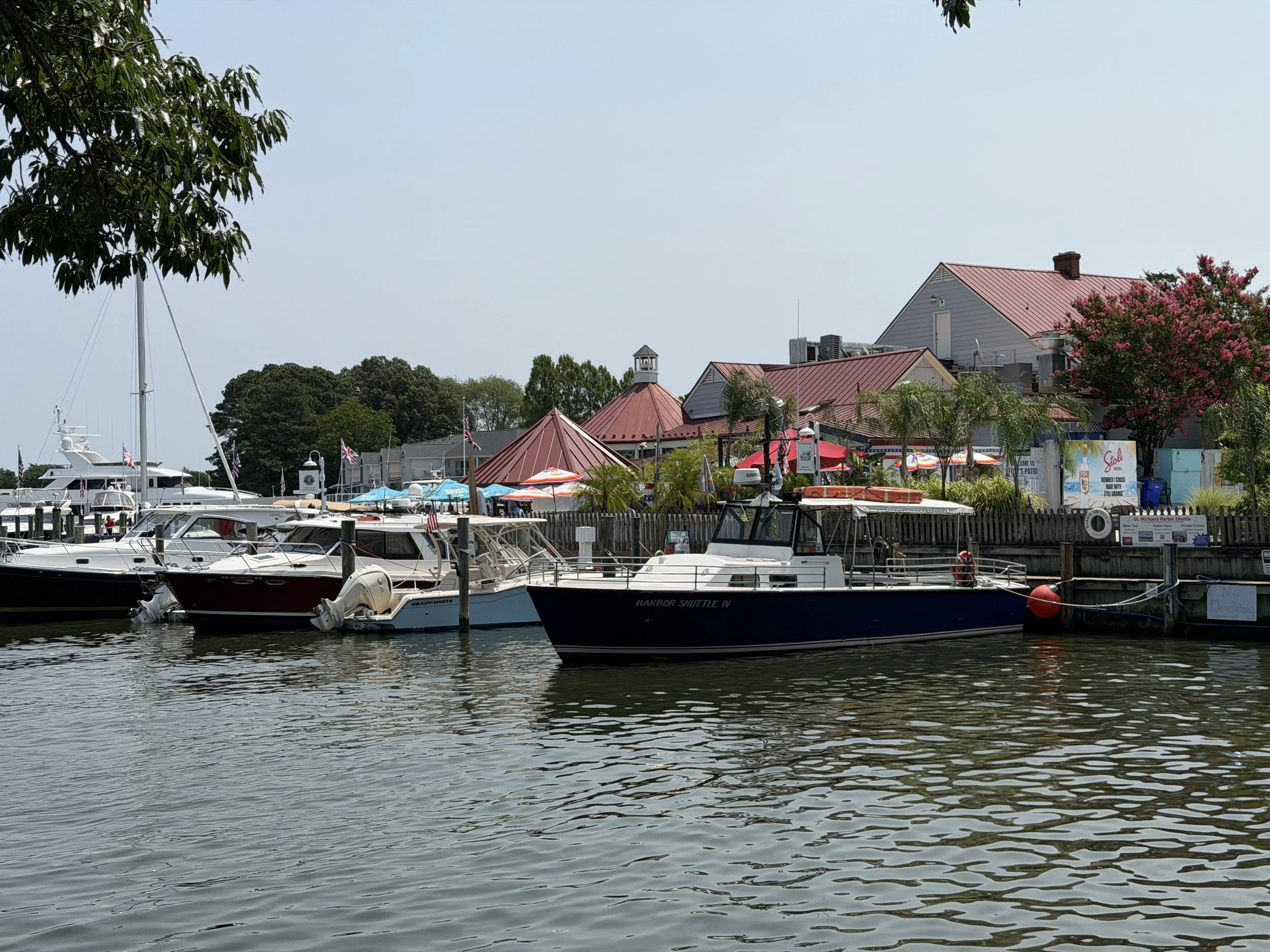
I’ve been to St. Michaels three times before I knew what was there.
We stayed at Inn at Perry Cabin one year. Came back another year with the kids for the Christmas parade. Drove out again this summer for brunch. If you had asked me about the town after any of those, I would have told you it's pretty, it's on the water, and it's quiet. All three are true. But there's more to it.
The drive takes about an hour and a half from our house, and the change starts as soon as you turn off Route 50. Corn fields open on both sides. The big houses are there, but you don't see them. They sit back behind the trees, at the end of long driveways.
We got there around ten in July, on a day nice enough that everybody else was out too. Across the street, outdoor tables were already filling, but Bistro St. Michaels had only recently started serving brunch and still had a booth open. We ordered the Bistro Breakfast, split the brioche French toast and listened to the kitchen answer “yes, chef” as tickets came in.
By the time we stepped outside, Talbot Street had filled.
What I noticed most was the quiet.
The brunch crowd was out. People were shopping, families were walking, cars kept coming down the main street. Nobody was loud. No shouting, no music from open windows, nothing disturbed the quiet.
Everything for sale on the main street is about the water. Nautical art in the windows, sweatshirts and caps, gift stores full of small painted things. The clothing leans preppy. A small town with a hint of a resort town.
I do a thing when I go somewhere new. I look for other Black people. Some signal, in a place where I don't see many of us, that I'm welcome. Like what a town puts on its shelves and its walls. Or just how we're treated once we're in the room.
We stopped in Book Hounds, a small bookstore on Talbot Street. In the children’s room, two shelves face you as you walk in. John Lewis. Maya Angelou, illustrated by Basquiat. Baldwin. Somebody chose those. That is a marker, and you learn to read them.
Outside, I saw very few Black people on foot. Most of those I noticed were driving along Talbot Street in their Sunday clothes, coming from church and continuing past the main stretch.
Everyone we encountered in St. Michaels was pleasant.
It is a good town for a Sunday, and it knows it.
We ended up under a big tree at the water's edge near Foxy's Harbor Grille. A father and son were throwing a ball on the lawn. A few teenage girls were taking pictures under the gazebo. That's where Ms. Hattie came through in her motorized wheelchair and asked if we would take her picture to send to her sister in North Carolina. She was on her way to Foxy's for what she said was the best hamburger around. We talked for a few minutes about life. I remember the conversation because strangers don’t often stop, talk and stay long enough to tell you something about their lives.
After three hours we drove home content.
That was the St. Michaels thought I knew.
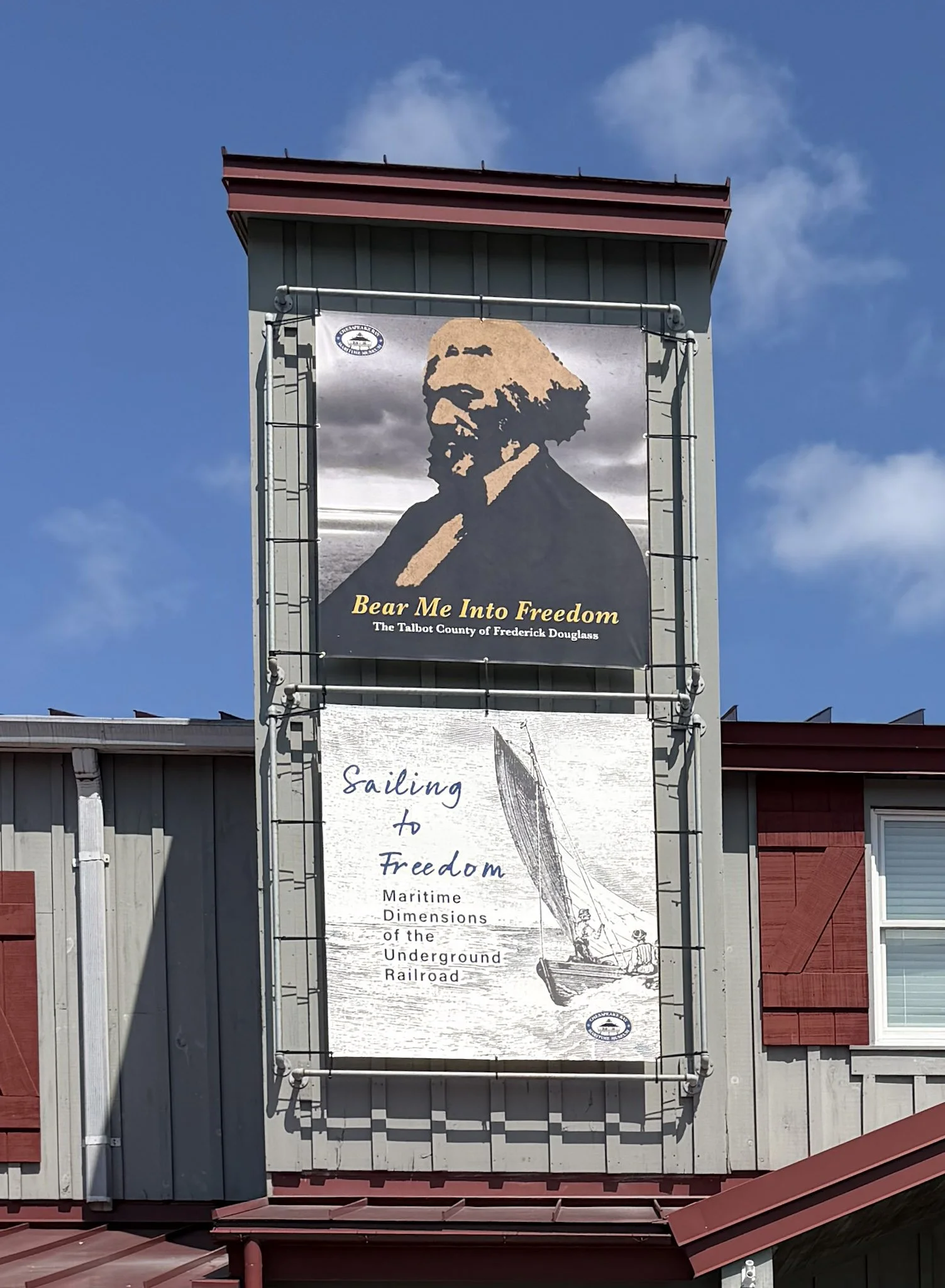
The main building covers watermen, duck hunting, and small boats, and what surprised me was that the Black history wasn't set off to one side of it. It runs through it. Black watermen knew that water, and that knowledge is what made them the guides visitors hired to fish and pull oysters. Women picked crabs for the packing houses, and they held contests to see who could pick fastest. That history is not separate from the maritime story. It is a part of it.
The one I stood in front of longest was Joseph Keene, who got out by water with his pregnant wife and seven children in a log canoe.
The Douglass exhibit is in a separate building, on the second floor, and the staff told us to start there and work our way down. It's built as a timeline you walk through, and it gave me the part I didn't have. I knew the abolitionist. I knew the older man with the white hair and the speeches. I did not know the boy, or the young man, and those years happened here.
The floor below is Sailing to Freedom, about the water routes of the Underground Railroad. It comes down this December. The Douglass exhibit runs through the end of 2027.
Out on the grounds is the Mitchell House, where Douglass's sister Eliza lived with her husband Peter and their family. My husband and I came out talking about the same thing, which was how small it is. Two rooms and a loft. You stand in the doorway and try to imagine a family fitting inside.
The signal I had been looking for came in pieces: Ms. Hattie under the tree, the children’s room at Book Hounds, the way we were served at brunch, the staff member who wanted us to know about the baptisms on the river, and a museum that treated Black history as part of the town’s history. That mattered to me.
How much of it will remain on view is a fair question. Sailing to Freedom closes in December 2026, and Bear Me Into Freedom runs through the end of 2027. When they close, what remains will be smaller and quieter: the Black watermen and crab pickers in the main building, and the Mitchell House on the lawn.
We’re going back for the boat tour, the Douglass driving tour and Easton, where more of this history is kept.
Three visits before I asked what else was here.
We went back a few weeks later for one thing: Bear Me Into Freedom: The Talbot County of Frederick Douglass.
The Chesapeake Bay Maritime Museum sits off the main street, down on the water. Eighteen acres of it.
I knew the history of slavery and escape ran through this part of the Eastern Shore. You pass signs for the Harriet Tubman Underground Railroad Byway on the drive out. I remembered from school that Frederick Douglass was from Maryland, but not much beyond that.
I learned about the exhibition after our brunch visit. Until then, I had never asked what had happened in St. Michaels itself. I did not know that Douglass had been enslaved here, in this town, on this water.
Admission is twenty dollars. There are free museums with much larger collections, including one an hour from my house in Washington. Here, though, the history is tied to the place where it happened. The water is outside the door. That is what the twenty dollars buys.
OUR POINT OF VIEWWe went. Here’s what we’d tell a friend.
The Visit only goes where we’ve been. This is the part you’d ask for over the phone: what was worth ordering, what’s actually on the street, and the practical details that decide whether a day works. What we’d skip, we say.
AT THE TABLE
Bistro St. Michaels. Sunday brunch is new. Short menu, open kitchen, and a booth if you want one. Order the Bistro Breakfast and split the brioche French toast. Brunch ends at 1:30 pm.
Foxy’s Harbour Grille. We didn’t eat here. Ms. Hattie says it has the best burger in town, and we’re inclined to take her word for it.
AROUND TOWN
Talbot Street. Walkable end to end. Nautical art, sweatshirts, painted things, jewelry and thrift stores.
Book Hounds. Independent, small and set in an old cottage. Look for the two shelves of Black children’s book in the children’s room.
Chesapeake Bay Maritime Museum. Give the museum two hours. The Douglass exhibit runs through 2027. Sailing to Freedom ends this December.
BEFORE YOU GO
Getting there. About ninety minutes from Baltimore. You need a car. Street parking fills on a good day.
The museum. Adult admission is $20 online and covers two consecutive days. A boat tour can be added.
Who might skip it. If you want nightlife or shopping with range, this isn’t it. The pace is genuinely slow.
On Our
Radar
Worth leaving the house for.
The few things we’re considering, planning around, or writing down early enough to remember next year.
September 11 to november 14 · FreeThe Long Ride Home: Black Cowboys in America
The Print Center, Philadelphia ·
Ron Tarver photographed Black ranchers, rodeo riders, and city riders in the 1990s; the work was finally published as a book in 2024. We plan to be there.
event details →September 18 and 19 · sold outBill Pickett Invitational Rodeo
Show Place Arena · Upper Marlboro
The country’s longest-running Black rodeo, and the closest it comes to us all year. We missed this year’s tickets, but it’s going on the calendar for next year.
know it for next year →saturday, september 26 · 10 a.m. to 3 p.m. · FreeFrederick Douglass Day
Downtown Easton, Maryland · Free
The parade ends at the courthouse statue the Frederick Douglass Honor Society helped bring to Easton. Twenty minutes from the town in this month’s Visit.
event details →september 24 to 27 · FreeThe Reunion
National Museum of African American History and Culture, Washington, D.C.
Ten years since it opened. The closing day moves to The Wharf, where the programming is built around the Pearl, 1848 attempt by seventy-seven enslaved people to escape by schooner. Some events need advanced registration.
event details →october 10 · 7 p.m. 8 Seconds Rodeo
Liacouras Center, Philadelphia
Bull riding, bareback bronc, barrel racing, and mutton busting’ for the small ones. Philadelphia has had Black stables since the Civil War and Fletcher Street is still running one. We’re listing it now because October’s issue would leave only six days.
event details →