The Visit
We go, we pay attention, and we tell you what makes a place worth the trip.
The Visit covers places we’ve experienced ourselves. We’re interested in more than what photographs well. We look for the history, small details, and people that make a place worth your time.
When the Names Were Called
A first visit to the ceremony honoring the people who built Norfolk Botanical Garden.
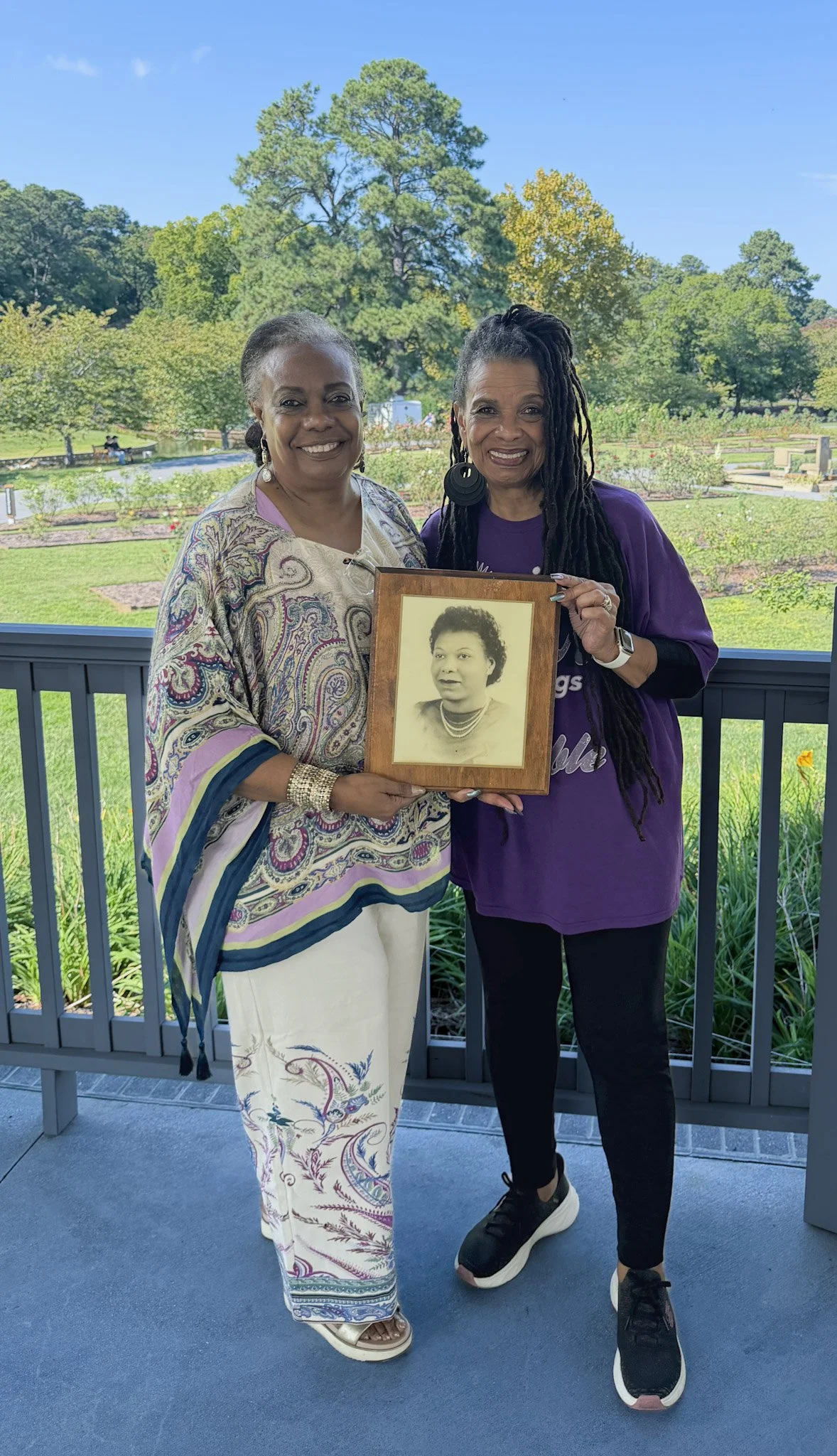
Bernadette and Ruverta hold a picture of their mother, Ruth Howell Holmes, after the ceremony.
I’d heard about Norfolk Botanical Garden’s annual WPA Heritage Day Celebration and wanted to see it for myself. I didn’t know what to expect. When we turned onto the drive and found a line of cars waiting to get through the gate, I realized this wasn’t going to be a small gathering. Attendants directed cars into a parking lot that was filling quickly. At Rose Garden Hall, a hostess handed us the program and told us it was standing room only. I found a seat in the back. My husband had to stand.
Then Delegate Jackie H. Glass of the Virginia House of Delegates spoke about family stories, who gets remembered, and who does not. “The women who moved it, planted it, shaped it were, for generations, largely remembered as shadows,” Glass said. “We’re often really good at remembering the people who can see the thing, and less practiced at remembering the people whose labor made the concept real.” She had the room’s attention. The women sitting beside me responded in low voices. “Mm-hmm,” one said. “That was powerful,” another whispered. Heads nodded around the room.
In 1938, 200 Black women and 20 Black men were hired through the Works Progress Administration, or WPA, a Depression-era program set up to provide jobs. They were assigned to clear the land and build Norfolk’s Azalea Gardens, which later became Norfolk Botanical Garden. For four years, they cleared trees and brush, pulled roots, and carried dirt by hand to build a levee around the lake. They worked in the heat, rain, cold, and around snakes, mosquitoes, ticks, and poison ivy. They were paid twenty-five cents an hour.
But after all that work, they couldn’t enter the garden as guests because of segregation. The records were incomplete, so the garden didn’t have all the names of the people who had done the work. Some families didn’t know that a parent or grandparent had worked there.
Then the daughter of Mary Elizabeth Ferguson, who had been the garden’s last known living WPA worker, began to read the names of the 75 known workers. Organizers said it was the largest turnout in the celebration’s history. People clapped after each name. When family members were there, they stood, sometimes shouting with pride. Grandchildren and great-grandchildren stood with them. Before I went, I had done my research and knew the garden had been built by WPA workers. But it wasn’t until I was in that room, watching their families stand to honor them, that I imagined them as mothers, fathers, grandparents, sisters, and brothers.
After the ceremony, families gathered outside for photographs in the garden their relatives had helped build. There, I met sisters Ruverta and Bernadette. They held a framed photograph of their mother, Ruth Howell Holmes. Ruth was 19 when she worked at the garden. She was the oldest of eight children, still in high school, and helping care for her siblings because her mother was ill.
In 2016, a member of the WPA committee contacted Bernadette to tell her that Ruth Howell Holmes had been identified as one of the original workers. Bernadette called her siblings with one question: “Did you know?”
Nobody knew.
They couldn’t think of anyone else who would have known, either. After learning about their mother, the sisters attended WPA Heritage Day. They have returned every year since. Ruverta said hearing the names overwhelmed her. “I actually sensed the presence of my mother, as well as the other workers,” she said. It made her think about her mother doing that work, then being kept out of the garden she had helped create. Ruverta brought a photograph of her mother to this year’s ceremony. “I purposed it this year to bring a picture of my mother, so when I stood up and started hollering, people would know that was my mother,” she said.
“I’m standing for her and what she had to go through and the sacrifices she had to make.”
RUVERTA, DAUGHTER OF RUTH HOWELL HOLMESBefore the ceremony ended, organizers announced that four additional workers had been recently identified. The search for the identities of the remaining WPA workers continues.
On Our Radar
Worth leaving the house for.
September 11 to november 14 · FreeThe Long Ride Home: Black Cowboys in America
The Print Center, Philadelphia ·
Ron Tarver photographed Black ranchers, rodeo riders, and city riders in the 1990s; the work was finally published as a book in 2024. We plan to be there.
event details →october 10 · 7 p.m. 8 Seconds Rodeo
Liacouras Center, Philadelphia
Bull riding, bareback bronc, barrel racing, and “mutton busting” for the small ones. Philadelphia has had Black stables since the Civil War and Fletcher Street is still running one. We’re listing it now because October’s issue would leave only six days.
event details →